
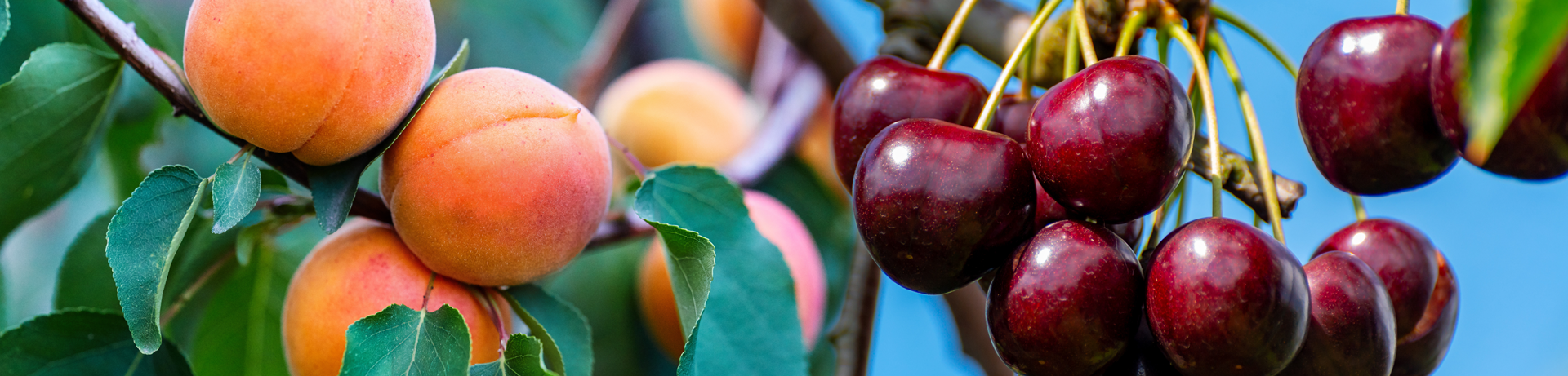
Most of New Zealand's stonefruit is grown in the Hawkes Bay and Otago regions. Stonefruit has been grown successfully on a wide range of soils with a pH range between 5.5-7.5. Yield is best on land that is not prone to water logging. Sites are chosen for good drainage through a combination soil characteristics and a sloping topography. In Otago a sloping site offers some protection from frosts.
Even top-class horticultural land will contain areas with less-than-ideal drainage caused by local irregularities in topography or in soil properties. Also, the soil may contain areas of low organic content or suffering from compaction. Localised gypsum applications can help to remedy these problems and will bring about soil structure improvements.
The improvement in soil structure obtained by adding gypsum is likely to improve the general health of stonefruit trees and reduce the chances of the trees suffering root disease problems such as phytophthora.
Calcium requirements
Stonefruit can suffer from premature softening, increased ethylene production and elevated respiratory rates, these have all been associated with calcium deficiency in the fruit. Post harvest storage of stonefruit can be improved by increasing fruit calcium status of the fruit while it is on the trees and can be achieved in a calcium deficient soil with the addition of gypsum.
A stonefruit orchard requires between 250 and 500 kg/ha of calcium each year. A substantial part of this can be supplied in the form of gypsum with other calcium-containing fertilisers accounting for the balance. Commonly with stonefruit, nitrate is applied in the form of calcium ammonium nitrate (containing 27% of nitrogen and 8% of calcium) at the rate of around 300 kg/ha. This supplies only 24 kg/ha of calcium so that most of the balance of calcium can be supplied in the form of gypsum.
Applications of gypsum will be determined by soil type and a recent soil lab test result.